
If Jaws Gets Bored, So Does Fluffy
What do sharks and cats have in common? Both need environmental enrichment. Learn how play improves cat behavior and mental health.
Jeffy the Journalist
11/2/20256 min read
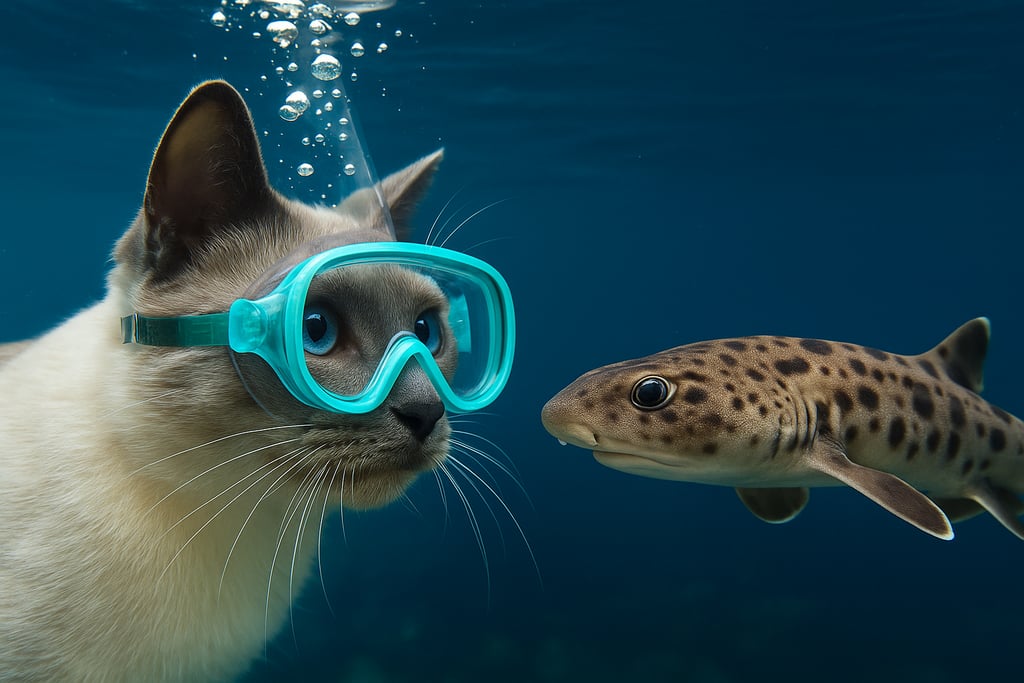
Jeffy goes underwater to investigate an uncomfortable scientific truth: sharks and housecats are both predators with a dangerous tendency to get bored. Image by Chatgpt.
The Mental Lives of Predators
There’s a remarkable similarity between cats and sharks. Both are stealth hunters powered by exquisite senses—whiskers or electroreceptors—built to detect the faintest hint of potential prey. Both stalk, pounce, and then pretend they meant to miss.
Predators Just Wanna Have Fun: From Aquarium Sharks to Apartment Cats
Watch the movie Jaws and you'll know what marine biologist Matt Hooper knew. A shark, he said, is “a perfect engine, an eating machine… all this machine does is swim and eat and make little sharks.”
For decades, that summed up how people viewed sharks—pure instinct wrapped in cartilage. And in a similar way, many folks think we kitties are self-sufficient mini-predators who require nothing more than a bowl of kibble and an occasionally scooped litter box. Feed ’em, scoop ’em, and call it good.
But science is throwing chum in those calm waters. A new study in the journal Applied Animal Behaviour Science shows that sharks—yes, sharks—like to play. Which means that inside that purring house predator snoozing on your couch lurks the same restless curiosity as a leopard shark named Bud, who spent his days in a California aquarium lovingly guarding a bright yellow rope hoop.
While in the study leopard sharks stole the spotlight, another member of the shark family is even more catlike. The name says it all: catshark. They’re sleek, small, big-eyed species named for their feline looks and sinuous, tail-swishing grace. They even curl up in coils to nap, just like the cat curled on your laptop. What’s not to love?
If even a catshark needs playtime, what does that say about your indoor tabby, gazing out the window, literally a predator trapped in suburbia? Both get bored. Spectacularly bored.
According to the study, lead researcher Autumn Smith of Biola University began her shark research because the captive animals just sat on the tank bottom, “staring at the walls.” Sound familiar? Indoor cats often mirror that same thousand-yard stare between naps. Without outlets for natural behaviors like stalking, climbing, or problem-solving, frustration builds until it erupts as aggression, excessive grooming or creative redecorating of the shredded-couch kind.
Leopard Sharks, Catsharks and Couch Leopards, Oh My!
When researchers dropped colorful swimming-pool toys into the tanks at Cabrillo Marine Aquarium, the sharks and rays first treated them like alien invaders, with the same suspicion Fluffy greets that new-from-the-factory armchair. Then curiosity took over. They nudged, batted, carried, and even swam through hoops. The leopard sharks were the most enthusiastic—logging as many as 120 interactions per hour. That’s right: the sharks were playing.
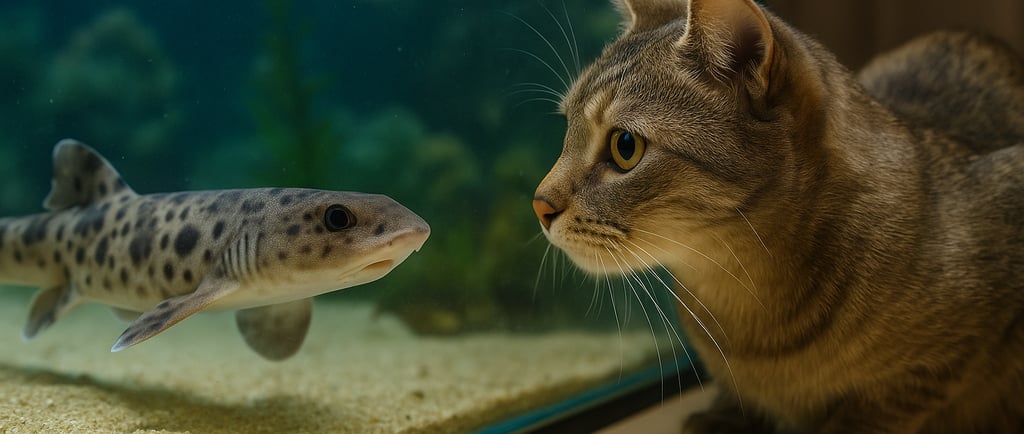
A leopard shark and a housecat face off across aquarium glass, two predators wired for curiosity, hunting and play. Photo created by ChatGPT.
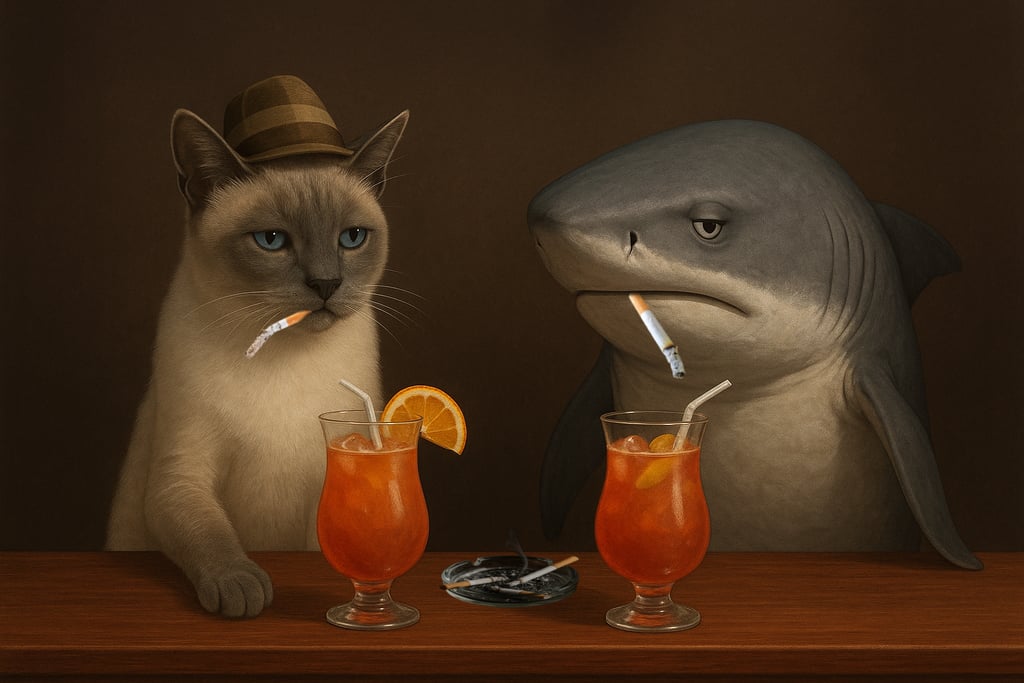
Bored predators often develop bad habits. The first step in changing nuisance feline behaviors is enriching the environment before Fluffy takes up smoking, drinking and organized crime. Image by ChatGPT.
If Jaws Gets Bored, So Does Fluffy
Imagine a shark circling a barren tank day after day. Now imagine your cat pacing the same four rooms, staring at the same motionless toy mouse. Both are predators evolved to hunt, chase, problem-solve and conquer. When those instincts have nowhere to go, trouble surfaces—sometimes as a nip, sometimes as a toppled lamp.
Environmental enrichment—providing outlets for natural behaviors—isn’t indulgence. It’s mental health care. A tired predator with an outlet for stalking, climbing, chasing and problem-solving is far less likely to redecorate your couch or ambush your ankles. Play releases endorphins and serotonin (Lin, 2013), reduces stress, and strengthens bonds between companions, whether finned or furred.
Here's where the humans get us into trouble. Enrichment comes before training. You can't train against unmet needs. A one-foot scratching post isn't going to lure Fluffy away from the sofa arm any more than a tiny, putrid litter box is going to convince him the carpet was a poor choice. Before humans start correcting behavior, they need to provide legal alternatives. Tall, sturdy scratching posts, clean roomy litter pans, interactive hunt-and-chase play, climbing opportunities, food puzzles and adequate resources give predators appropriate ways to burn off energy and express natural behaviors. First meet the need, then correct the behavior.
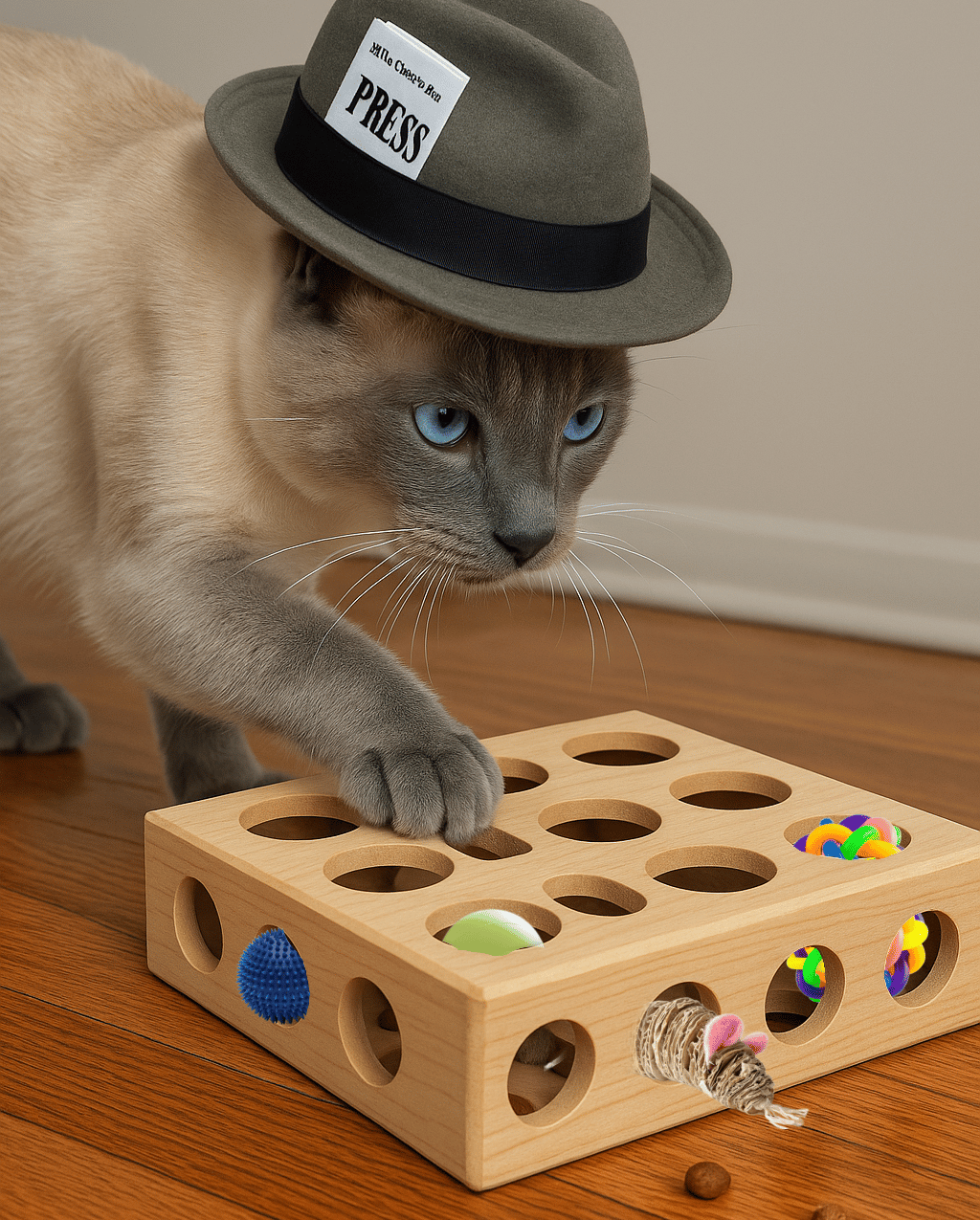
Jeffy the Journalist digs through a Pioneer Pet Peek-A-Prize puzzle toy filled with treats, balls and toy mice as part of his investigation into feline environmental enrichment. Image by ChatGPT adapted from photo by Weems S. Hutto.
How to Keep Your Cat from Becoming a Couch Shark
Food Puzzles: Food puzzles turn mealtime into a mission. They force us to strategize like the predators we were born to be. Put Fluffy’s kibble in either a Pioneer Pet Peek-a-Prize Toy Box or Peek-and-Play Toy Box, and cram it full of cat balls and fur mice. Fluffy has to pull all the toys out. No more boring grazing. Besides preventing boredom, food puzzles slow down gulpers, burn mental energy and reduce squabbles in multicat homes.
Choose interactive prey, not “dead” toys: Feather wands, teaser poles, motorized mice—anything that moves unpredictably taps into Fluffy’s inner hunter. Ten minutes of active play twice a day burns off excess energy that inspires fellow kitties to climb the curtains and replaces frustration with endorphin bliss. Not to mention, providing unpredictable movement makes the one with opposable thumbs gods to us. (Quite a reversal in roles, don’t you think?) Studies (Dantas, 2016) show that interactive play and food puzzles reduce aggression, stress, and destructive behavior in indoor kitties.
Rotate the toys: Novelty sparks interest. Put away half the toys and swap them out weekly. You can store them in jars of catnip. Woohoo. Even Bud the shark preferred new colors.
Nose Work: Sharks have tiny electrical sensors in their snouts. We kitties have 80 million olfactory receptors. Our feline sniffers can’t detect a drop of blood in a million gallons of seawater from thousands of yards away. Kitty nasal receptors, along with our whiskers, can detect motion, scent, and even air currents from nearby prey.
Scent-based games—“nose work”—tap into kitties’ natural hunting instincts by locating hidden treats or toys using smell. Your human can sprinkle a few treats in paper cups or cardboard boxes, hiding food in different rooms, or adding a pinch of catnip for motivation. Rotate scents (catnip, silvervine, valerian, or even your favorite human’s shirt) to keep it interesting. It’s a treasure hunt for the feline mind.
Build a world to explore: Cat trees, tunnels, cardboard forts and window perches create vertical territory and visual stimulation.
A well-enriched cat doesn’t just live indoors; it thrives there—and might even stop knocking your pens into the abyss.
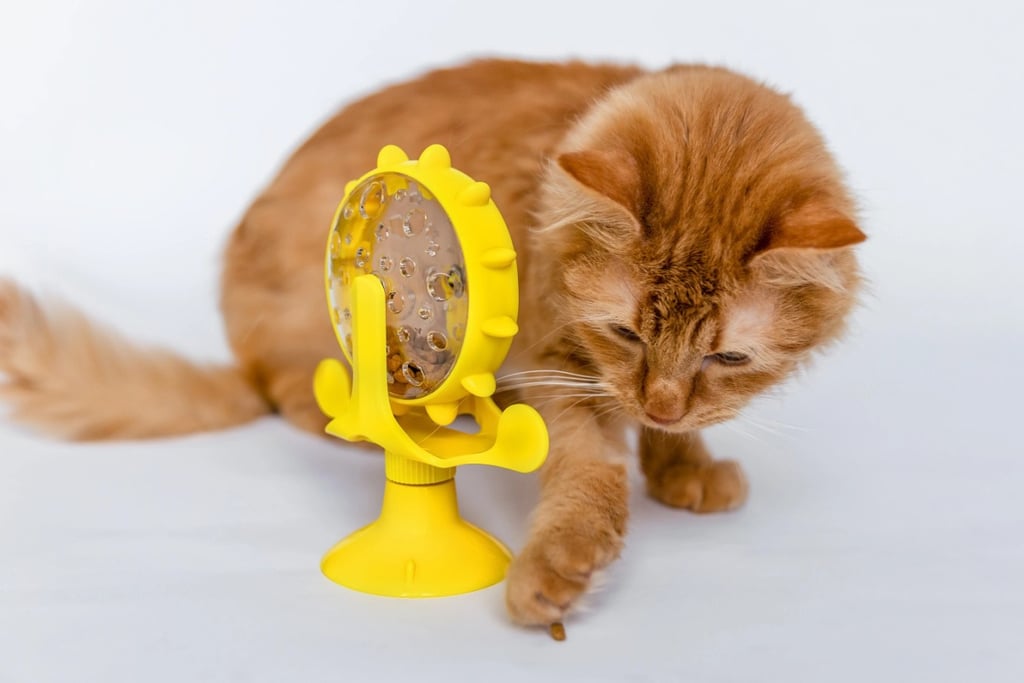
Like Bud the leopard shark and his beloved yellow ring, indoor predators thrive when meals become a challenge instead of a bowl of boring beige crunchies. photo by Deposit Photos.
The shark study reminded scientists that even animals we’ve dismissed as instinct-driven machines possess complex inner lives. Play behavior signals intelligence, creativity, and emotional need. Whether it’s a leopard shark twisting through a hoop or a house cat batting at invisible prey, both are saying the same thing: I need to do, not just exist.
So humans should channel their inner biologist and conduct enrichment experiments within the indoor habitat. Observe, hypothesize, adapt. Who knows? You might discover that the key to peace between your cats—and survival of your furniture—is as simple as a ten-minute play session and a well-placed cardboard box.
After all, Bud the leopard shark had his yellow ring. Your cat’s happiness hinges on your willingness to play scientist—and throw that toy.