
Gravity: It’s the Law. Cats Are Repeat Offenders.
Dusty Rainbolt
4/5/20263 min read
The key lies in Fluffy’s spine — specifically, in how different parts of it behave during a fall. The section running from the shoulder blades through the rib cage is remarkably flexible. In contrast, the lower back, just behind the rib cage, is much stiffer and more stable.Step-by-step demonstration that when it comes to cats, gravity is negotiable.
When researchers examined feline spines and analyzed high-speed footage of cats in midair, they found that cats don’t twist as a single unit. Instead, they rotate in sequence.First, the front half of the body turns, driven by the highly flexible section of spine through the rib cage. Then the back half follows, guided by the more rigid lower back. This allows Fluffy to reorient himself without pushing against anything — no surface required and no violation of physics after all.
Anyone who has cats knows that, like the little aliens they are, they aren’t bound by the physical laws of time and space the way we mortals are. Their occasional dalliances into alternate realities are most obvious when gravity should win — and doesn’t. Or at least that’s how it seems. Gravity almost always wins, especially when your cat tests its effects on your late grandmother’s Ming Dynasty vase.
When it comes to cats themselves, they not only ignore the law, they flick their whiskers at it.
We’ve all seen the slow-motion scientific videos. Fluffy is held on his back and dropped. Instead of a thud, he performs a midair twist worthy of an Olympic gymnast and deftly lands on his feet. No panic. No flailing. Just a controlled rotation that suggests he planned it that way all along.
For years, scientists have tried to explain exactly how cats pull off this gravity-defying maneuver. We’ve known about the righting reflex — the ability of a falling cat to orient himself feet-first — but the mechanics behind it have been harder to pin down.
A recent study published in The Anatomical Record (Higurashi, 2026) gets us closer to the answer, and it turns out the secret isn’t magic. It’s engineering. Feline engineering.
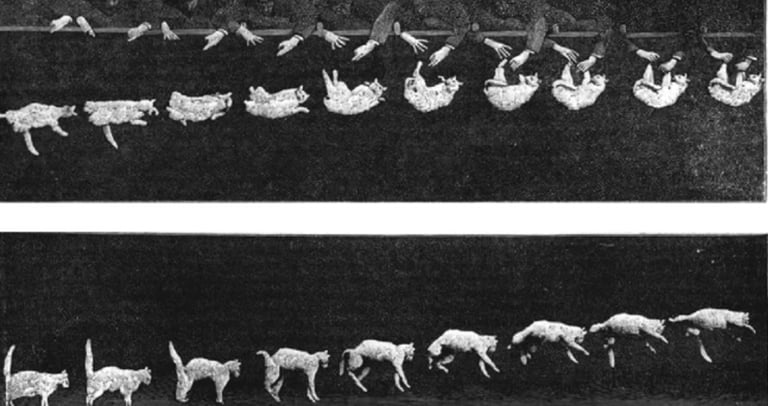
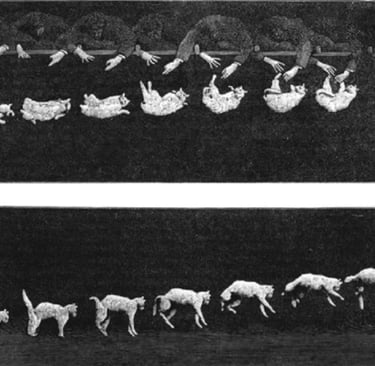
Step-by-step demonstration that when it comes to cats, gravity is negotiable. (Eadweard Muybridge, Animal Locomotion, 1894. (Public domain)
The spinal section through the rib cage also has a greater range of motion and what scientists call a neutral zone, meaning it can rotate more freely before resistance kicks in. The lower back, being stiffer, provides the control and alignment needed for a proper landing. In other words, cats don’t break the laws of gravity. They just exploit them better than the rest of us.
Of course, landing on their feet isn’t the whole story. Cats also have a phenomenon known as high-rise syndrome, which sounds impressive but usually involves a trip to the emergency clinic. Interestingly, cats don’t just survive short falls — they often do better after falling from greater heights. Studies have shown that once a cat has enough time to complete that midair rotation and relax his body, he spreads out slightly, increasing drag and reducing impact. There’s even a sweet spot, often reported around five to nine stories, where injury rates can be lower than from shorter falls. Below that, the cat may not have time to right himself. Above that, physics starts winning again.
Of course, this still leaves one important question unanswered: If cats are such masters of gravity, why do they insist on testing their skills by knocking objects off tables in the first place? Science, as always, has its limits.
Resources
Higurashi, Y., Kaino, Y., Habara, M., Okamoto, S., Yoshizaki, K., Sakurai, M., & Morimoto, M. (2026). Torsional flexibility of the thoracic spine is superior to that of the lumbar spine in cats: Implications for the falling cat problem. The Anatomical Record, 1–10. https://doi.org/10.1002/ar.70165
Whitney WO, Mehlhaff CJ. High-rise syndrome in cats. J Am Vet Med Assoc. 1987 Dec 1;191(11):1399-403. Erratum in: J Am Vet Med Assoc 1988 Feb 15;192(4):542. PMID: 3692980.
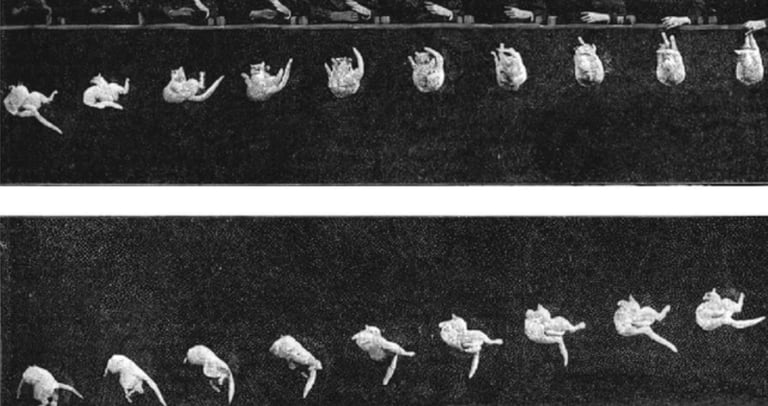
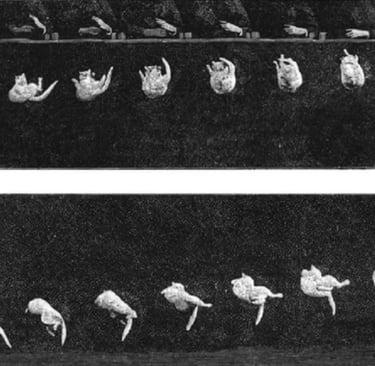
Cat vs. Gravity. Felines still undefeated, (Eadweard Muybridge, Animal Locomotion, 1894. (Public domain)
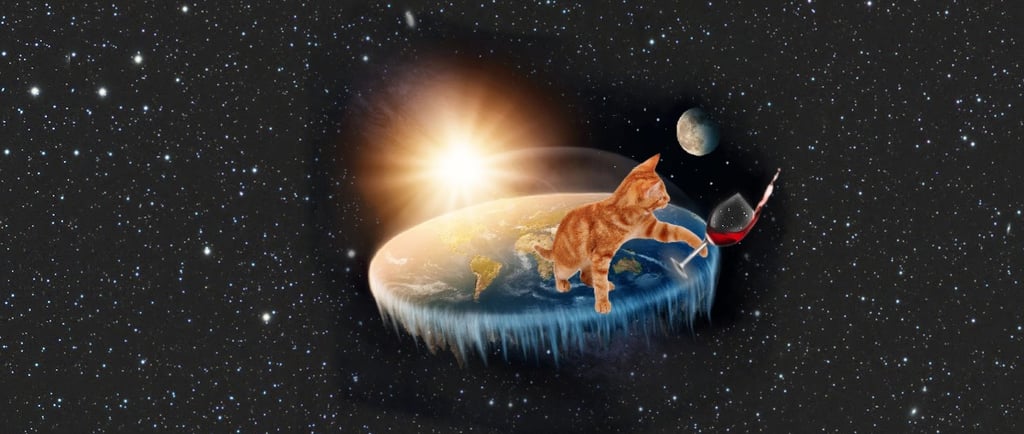
Cats, wine and gravity. The outcome was inevitable. (Composite by Dusty Rainbolt. Composite image created by Dusty Rainbolt using licensed images from Shutterstock.